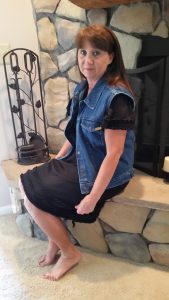
The OTvest provides trunk stability, tremor and spasm reduction In MS and Movement Disorders
The OTvest™ Weighted Vest Provides Trunk Stability for Multiple Sclerosis and Other Movement Disorders — Helping Reduce Tremors and Improve Balance
Experience greater stability with the OTvest™. Designed with effective, strategic weight placement, the OTvest™ helps support trunk stability, balance, motor control and tremor reduction.
This simple, non-invasive intervention can make a meaningful difference for individuals managing movement challenges—helping them feel more grounded, steady, and in control throughout the day.
Videos of Real Life Wearers of the OTvest
7 Sizes to Fit All Ages and Gender
For Multiple Sclerosis and Other Movement Disorders
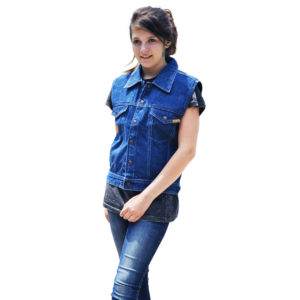
The OTvest is styled for wearers of all ages and gender
Experience the increased stability of wearing the OTvest™. Designed by an occupational therapist (trained by the Bobaths in NDT), the OTvest™ utilizes strategically placed weight to provide deep pressure therapy that helps stabilize the trunk, improve balance, and reduce tremors. This simple, non-invasive intervention can make a meaningful difference in daily life.
The OTvest™ denim weighted vest can be used as a gentle, natural treatment option for individuals with movement disorders such as multiple sclerosis, Parkinson’s disease, ataxia, dystonia, and other degenerative neurological or muscular conditions.
Deep pressure feels good and helps calm and stabilize
How the OTvest™ Works
The deep pressure therapy provided by the OTvest™ delivers proprioceptive input to the joints and muscles, helping the brain better understand where the body is positioned in space. This sensory input improves coordination and body awareness without the wearer needing to visually monitor their movements. For exampled, proprioceptive input allows us to know, without looking at our arm, that our arm is behind us, next to our body, or up in the air, for example.
Proprioception and kinesthesia—our internal sense of body position, movement, and force—are essential for balance and controlled movement. The OTvest™ enhances these systems by compressing the joints and encouraging co-contraction of muscles. The result is improved postural stability and increased awareness of body positioning.
Trunk Stability for Better Function
The OTvest™ applies comfortable, deep pressure across the shoulder blades (scapula), upper back, and upper chest. Weight placed across the shoulder girdle encourages the scapula to rest more securely against the back, improving trunk stability, postural control, and tremor reduction.
When the trunk is stabilized, movements of the arms and hands become more controlled. Everyday tasks such as:
Drinking from a cup
Combing hair
Keyboarding
Holding utensils or a pencil
Brushing teeth
can be performed with greater accuracy and less tremor.
Deep pressure is also applied by the OTvest throughout the day.
Designed by an Occupational Therapist
The OTvest™ was designed by occupational therapist N. VandenBerg, MS, OTR, NDT-trained/ Bobath-trained by Berta and Karel Bobath. In her years of clinical practice, she observed that adding targeted weight to the upper trunk (shoulder-girdle) could significantly improve distal (arm-hand) coordination.
In one example, a three-year-old child with encephalitis, low vision, and severe uncontrolled arm movement was unable to pick up toys. When fitted with the OTvest™, the child immediately gained enough trunk stability to reach, grasp, and play—an essential foundation for later self-feeding and fine motor development.
Similar benefits have been observed in adults, including individuals in their late 90s, who report reduced tremors and improved ability to perform daily activities.
What Wearers and Clinicians Are Saying
“The vest has been amazing. It has actually made my arms usable again… The dystonic movements are almost gone with the OTvest™ on.” — Jennifer Zubko, dystonia and ataxia
“The OTvest™ makes my feet feel more like they are touching the ground. I feel grounded, more secure when walking.” — Lili Kazepis, cerebellar ataxia
“With the vest, I am able to walk without swaying… It gives me a feeling of security and helps me get things done.” — Robin Stevenson, cerebellar ataxia
“We have noticed a remarkable difference when walking with the OTvest™ versus without it. She is far more stable and confident.” — Eileen Branham, PT
Woman with ataxia in the size small, 3 lb OTvest
“When I put it on while dizzy, the dizziness disappears almost immediately.” — Peter Lee, cerebellar ataxia
Supported by Research
Research has demonstrated that applying weight to the shoulder area of individuals with cerebellar ataxia, including those with multiple sclerosis, can significantly reduce lateral (side-to-side) sway:
Lucy & Hayes (1985) showed improved stability with six pounds of weight¹
Widener, Allen, & Gibson-Horn (2009) demonstrated improvement with even less weight²
With the dense weights and shoulder-girdle placement of the weights in the OTvest™, less weight is effective in the smaller sizes, only needing 6 lb. in the size XL/XXL to be effective.
These research findings align with the real-world outcomes reported by OTvest™ wearers.
A Natural Option for Movement Disorders
If you are looking for a non-invasive, drug-free option to support trunk stability, balance, and tremor reduction, the OTvest™ weighted vest may provide the grounding and control you need to move with greater confidence.
Video of a Woman with Ataxia and Her Physical Therapist--Footage of Robin walking without the OTvest
Robin, an OTvest™ wearer with cerebellar ataxia, began using the OTvest, ™weighted vest in hopes of reducing her lateral sway. In her case, the OTvest™ proved so effective that when wearing it, she no longer needs to hold onto a wall or rely on support from her physical therapist for stability.
Robin’s before-and-after experience with the OTvest™ was recorded and is demonstrated in footage below. She invited OTvest™ to film her during physical therapy because of her strong desire to help others living with ataxia.
NOTE: In this video, Robin is wearing an OTvest™ size medium with 4lbs of weight.
Look for the yellow "OTvest™" label on the chest pocket to make sure you are getting the genuine OTvest™.
The genuine OTvest label
Others may look like the OTvest™ from the outside, but the weight placement is important.
Only the OTvest™ has the patented weighted insert with weight lying directly upon the body. This makes the difference!
Note: The OTvest™ is not recommended for those with spinal cord problems and the accompanying balance problems associated with those disorders, such as herniated or dislocated discs, degenerative disc disease, or other spinal cord injuries. The balance problems that benefit from the OTvest, weighted vest are those with upper motor neuron and/or cerebellar problems described in the first paragraph.
References:
Chase RA, Cullen JK, Sullivan SA. Modification of intention tremor in man, Nature 1965;4983:485-7.
Clopton N, Schultz D, Boren C, Porter J, Brillhart T. Effects of axial loading on gait for subjects with cerebellar ataxia: preliminary findings. Neurol Report 2003;27:15-21.
Gillen, G. (2000). Improving activities of daily living performance in an adult with ataxia. American Journal of Occupational Therapy, (54)1:89-94.
Hewer RL, Cooper R, Morgan MH. An investigation into the value of treating intention tremor by weighting the affected limb.,Brain 1972;95:570-90.
¹Lucy SD, Hayes KC. Postural sway profiles: normal subjects and subjects with cerebellar ataxia. Physiother Can 1985;37: 140-8.
Morgan MH, Hewer RL, Cooper R. Application of an objective method of assessing intention tremor–a further study on the use of weights to reduce intention tremor. J Neurol Neurosurg Psychiatry 1975;38:259-64.
Morgan MH. Ataxia and weights, Physiotherapy 1975;61: 332-4.
Smedal T, Lydren H, Myhr KM, et al. Balance and gait improved in patients with MS after physiotherapy based on the Bobath concept. Physiother Res Int 2006;11:104-16.
²Widener GL, Allen DD, Gibson-Horn C. Balance-based torso-weighting may enhance balance in persons with multiple sclerosis: preliminary evidence. Arch Phys Med Rehabil 2009;90:602-9.
MORE DETAILED FEEDBACK IN LETTERS FROM CUSTOMERS WITH MOVEMENT DISORDERS
Those who have used the OTvest™ as a treatment for multiple sclerosis, as treatment for dystonia, as treatment for ataxia, and so much more, have written letters explaining how much the OTvest™ has benefitted their lives. These are more complete quotes of their letters:
"The OTvest™ makes my feet feel more like they are touching the ground. I feel grounded, more secure when walking."
Lili Kazepis, Brooklyn, New York cerebellar ataxia
"I got the OTvest™ (sic)… and I was able to sleep through the whole night. Usually, I have to take medication but I haven’t had to touch it since I got the vest. The OTvest™ helps me to stabilize my trunk… with the vest, I am able to walk without swaying back and forth and having to hold on and grab things. It helps give me a feeling of security..it helps me get things done."
Robin Stevenson, Gainsville, Florida, cerebellar ataxia (quoted from video, linked above)
"In physical therapy we have been working on stability and core control (with Robin). We have noticed a remarkable difference when walking with the OTvest™ and walking without it. When she first came to physical therapy, she wouldn’t walk in a crowd because she thought she would fall and now she is able to walk through the gym with other patients coming in when she wears the OTvest™. She is far more stable and confident."
"Just received my OTvest™ less than an hour ago. I love it and can already tell I am using my arms better. I am even being more accurate with the keyboard as I sit to type this. My PT and therapeutic riding instructor have been working very hard on my shoulders and arms this week, as they were extremely tight. I put on the vest and they went immediately limp. It is as if I don't have any tone at all in that area, which of course, has calmed my whole system down. The vest feels very much like my therapist's hands constantly on my shoulders. First impressions are that I love it! I don't want to take it off! Thank you for everything."
first letter from Jennifer Zubko, Canada, dystonia
"The vest has been amazing. It has actually made my arms usable again… to play the keyboard. [I] learned that if I wear the vest, I have more use of my more affected left hand, and can isolate the keys better...The dystonic movements are almost gone with the [OTvest™] on."
second letter from Jennifer Zubko, dystonic adult in Canada (ataxic)
"The vest seems to keep me straight not going to one side like I do. It makes me walk more straight without leaning towards one side. I am 50, had Ataxia SCA1 since 38, 130 pounds, wear 10 or 12. The vest has the 3 pounds... It works good with keeping me more balanced and grounded. My muscles are very weak and sore from the ataxia. I also can't button things. The snaps work great." Cathy Letson, Sca 1 ataxia, Claxton, GA
"I have been using the vest for about a month now.
Although I bought it to help my walking, instead, I use it to reduce my dizziiness. When I put it on when I am dizzy, it disappears almost immediately. It really is so effective. Then I lie down on my lazy chair for around 10 minutes and I am ok. My OTvest is with me now 24 hours a day.