What’s the difference between a pressure vest and the weighted OTvest™?
A pressure vest (also called a compression vest) is typically made of neoprene and provides a tight, squeezing sensation around the trunk. These vests are worn over clothing and often have a clinical or therapeutic appearance, leading many wearers to cover them with another shirt. Layering can make them harder to put on and remove, sometimes requiring assistance—which can make the wearer feel more conspicuous. Neoprene also tends to trap heat and absorb perspiration, making it uncomfortable for extended wear or multiple users.
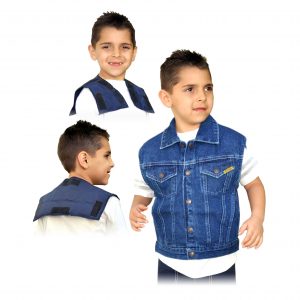
The OTvest®, by contrast, is a weighted vest that provides deep pressure through strategically placed, evenly distributed weights across the upper back and upper chest. This patented design increases trunk stability and body (kinesthetic) awareness while remaining comfortable and breathable.
The OTvest can be worn over lightweight clothing or even hoodies, allowing wearers to cover their head if that helps reduce distractions. Snap closures make it easy to put on and remove independently. The armholes are designed for airflow, and the breathable cotton fabric does not readily absorb perspiration. The removable weight insert can be wiped clean, making the OTvest ideal for classroom and clinical use.
Because of its durability and design, the OTvest can be used by multiple wearers and withstands years of daily use—making it a practical, cost-effective option for ADHD, anxiety, autism, and more. Perfect for school budgets requiring quality, effective weighted vest –able to hold up over 10+ years of daily use.
“How does one clean the OTvest?”
“What is the benefit of the weights for trunk stability?”
An increase in trunk stability through the OTvest’s strategic weight placement is especially beneficial for individuals with balance and movement challenges. This includes conditions such as ataxia (lateral sway), dystonia, multiple sclerosis, and certain types of cerebral palsy.
Placing weight proximally on the trunk helps improve distal control (situated away from the center of the body), which may reduce upper-extremity tremors and improve motor coordination. For this reason, the OTvest may be used as a treatment support for Parkinson’s disease and related movement disorders.
The upper-body weight placement can also help stabilize the neck and head, supporting improved swallowing, feeding, and other oral-motor skills—making the OTvest useful for some oral-motor conditions.
“Is there a recommended wearing schedule?” Protocol for use of an OTvest, weighted vest or sensory vest, deep pressure vest
Rather than focusing on wearing the OTvest™ for a specific number of minutes, it is often more effective to think in terms of “blocks of activity time.”
The OTvest™ is best worn before or during challenging activities, and removed once the activity is complete. This functional approach is especially helpful when the vest is used as a classroom intervention for conditions such as ADHD or autism. Examples of challenging activity blocks may include reading time, writing tasks, or lunchtime. For adults, this might include morning routines such as drinking coffee or brushing teeth.
The OTvest™ should be used in a practical way—activities should not be interrupted simply to remove the vest. Allow the individual to complete the task first.
To support sleep, the OTvest™ may be worn for approximately 30–60 minutes prior to bedtime.
For individuals with movement disorders, balance challenges, or trunk instability, the OTvest™ should be worn during tasks that require optimal motor control, even if those tasks last several hours.
Because individual needs vary, guidance from a physical or occupational therapist is recommended. Observation of the wearer is important, and gradually increasing wear time may be necessary in some cases.
A specific OTvest™ Protocol and accompanying Data Sheet are available due to the vest’s unique and important weight placement.
HERE IS THE OTvest™ PROTOCOL FOR THE USE OF A WEIGHTED VEST–Specifically for the OTvest because of the UNIQUE and IMPORTANT WEIGHT PLACEMENT, and an accompanying OTvest Data Sheet, if needed.
“Should I put the OTvest™ on an individual that is very agitated?”
Ideally, the OTvest™ should be applied before agitation becomes severe, which may require practice in recognizing early signs of sensory overload.
Sensory strategies such as rocking, music, swinging, or brushing can be helpful for soothing agitation and may be used alongside the OTvest™ as part of a comprehensive sensory program.
While the OTvest™ can be used to help decrease agitation, it is most effective when the individual is already familiar with wearing it in positive, calm situations. This familiarity increases acceptance and willingness to use the OTvest™ when sensory overload or agitation begins to escalate.
“Is the OTvest™ appropriate for both children and adults?”
The seven sizes of OTvests™ fits children, teens, and adults. The bottom of the vest fits more to the waist on most adults due to height, and is hip length on most children–covering the longer T-shirts that are popular. One’s chest measurement and weight is the best indicator of size.
“How long does it take to receive an order?”
Not long!
The OTvest is generally shipped within 2-3 days of receiving an order, with delivery in 2-3 days after it is mailed (within the United States). International deliveries can take 6-10 business days.
“How long has OTvest, LLC been in business?”
We have been providing the OTvest to buyers across the USA and internationally since 2002. We are member of the Better Business Bureau with A+ rating.
“Is satisfaction guaranteed?”
Absolutely!
Return for a refund within 30 days or exchange for a different size. REFUNDS: Refunds are for the price of the OTvest minus a $15.00 restock fee and received back within 30 days. Shipping is not refundable, and returned shipping is paid by the customer. Returned OTvest’s must be in re-sellable, unaltered condition (no odors, pet hairs, etc). NO INTERNATIONAL REFUNDS. Please email otvest@otvest for any questions or to advise us of a return/exchange. Details can be found on the ORDER page.
“How can I get more information?”
There is a great deal of information on the web site, with more detailed information for more specific conditions and applications under the LEARN link.
Please call us for details at 269-329-3287 or email otvest@otvest.com if you need more assistance in ordering an OTvest.